
What You'll Find Here
In my last post, I shared how I ended my piano journey in China with a sense of relief, having passed ABRSM Grade 7 exam but feeling completely burnt out.
I was sure my relationship with music was over, and I had no intention of ever playing the piano again.
If you haven’t read Becoming a Pianist Part I, find out why I felt this way here. 👇🏻
When we moved to New Zealand, I didn’t touch a piano for years. What I didn’t expect was that a new teacher and an impossible goal would not only reshape my music path, but change my entire understanding of what music could be.
This is the story of how I found my way back — and why the second time was entirely different.
The Deal That Brought Me Back
My mum, ever persistent, eventually brought up the subject of piano again. I was 16 at the time. She made me a promise — one she knew I couldn’t refuse.
She said she would never force me to play the piano again if I could just get one final qualification: an ATCL performance diploma from Trinity College London.
- For her, it was a point of pride.
- For me, it was a strategic exit.
I saw it as a way to end my piano career on a high note — something impressive to mention at school before closing the lid for good.
So, I agreed.
Impossible, I Was Told
We found a Chinese teacher in New Zealand who, as luck would have it, had been trained at the same Conservatory of Music as my childhood teacher.
It felt familiar, almost like fate. But after just a few lessons, he sat us down. He said that while my basic piano technique was okay, I wasn’t a teachable student. Simply put, I had no talent.
He was blunt. He urged my mum and me to quit the goal of passing ATCL in such a short time. His reason was practical, not personal, of course.
He explained that if a student failed a high-stakes exam like the ATCL, it could hurt the teacher’s reputation and make it harder for them to attract new students.
His request for us to find another teacher was a business decision. And it was utterly disheartening.
By that point in my life, I’d already built up a pretty solid stubborn streak. Him telling me I couldn’t do it didn’t make me want to give up. It did quite the opposite actually. It lit a fire under me.
All I could think was, “Right, I’ll show you.”
The Piano Teacher Who Changed Everything
After that experience, we decided to try a completely different approach and look for the best piano teacher in Auckland.
Our search led us to Mr. Bruce Baker.
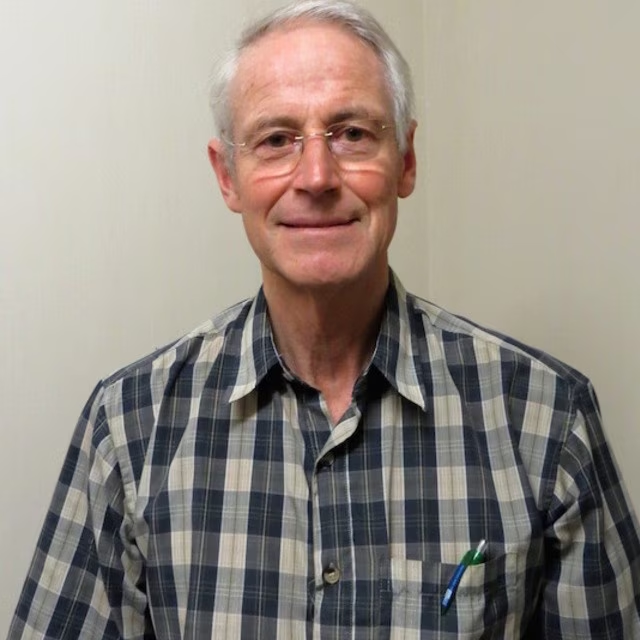
When we told him our goal of passing ATCL diploma, he actually let out a long sigh.
He was honest from the start, and hinted that we should not be too optimistic. He said passing an exam so far beyond my capability, and in such a short time, was highly unlikely.
He didn’t agree with mum’s expectations, but he saw something in me. He promised he would still give it his best.
To me, this promise wasn’t just a blind encouragement, but it was a realistic commitment, and that meant a lot.
The 3 ATCL Pieces I Chose
And so, my musical journey took a new turn with Mr Baker.
Still holding grudges from my previous piano teacher, I made a move that was probably a bit rebellious.
I chose 3 of the hardest pieces to play for the ATCL exam. It was my way of making a point.
- Chopin: Polonaise No. 1 Op26
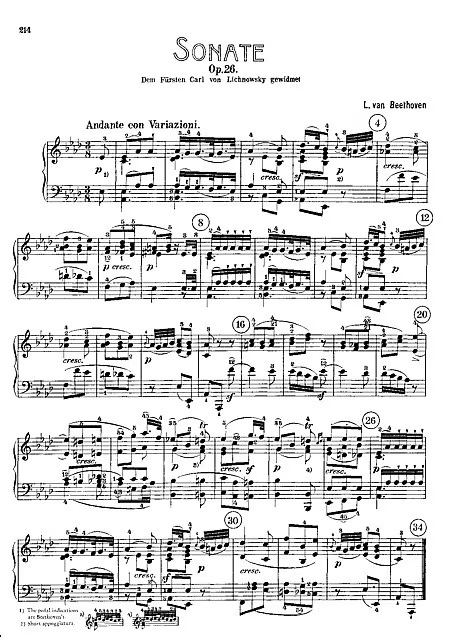
- Beethoven: Sonata No.12 Op.26
- Ravel: Le Tombeau Du Couperin
The moment I saw the music sheet for Beethoven’s Sonata No. 12, I immediately regretted my choice. 😔
The page was covered in what looked like crawling ants, and the piece was a whopping 20 minutes long!
I remember thinking, how would I ever be able to memorise all this for the exam?
The Shift From Technical Precision to Musical Expression
Mr. Baker’s teaching was nothing like what I was used to.
Our first lessons weren’t even about playing. We spent what felt like a lot of time on music theory and, to my initial frustration, talking about the lives and stories of composers like Beethoven and Chopin.
Given how much the piano lessons cost, my mum and I were a bit confused at first.
Why weren’t we just drilling the pieces?
Mr. Baker explained his approach. He told me I needed to stop worrying so much about playing a wrong note.
Instead, he wanted me to focus on the flow of the music and to express myself freely.
It was a complete reversal of everything I’d been taught about learning piano as a child.
It was during these discussions about the “why” behind the music that Mr. Baker noticed I had a knack for composition. He saw something in me I didn’t even see in myself! (More on this in Part 3 of Becoming a Pianist)
Slowly, something shifted. I began to actually appreciate the music, and for the first time in as long as I could remember, I started to genuinely enjoy sitting at the piano.
His guidance and encouragement weren’t just about passing an exam; it was about reigniting a passion I thought was long gone.
The world of music that he introduced to me was actually… interesting!
The Breakthrough
During a memorable piano lesson a few months in, something changed.
Mr. Baker stopped me mid-piece. He looked at me, surprised, and said, “Something just clicked.“
He couldn’t quite pinpoint what it was, but he said my playing had a certain authenticity — something he believed the judges at Trinity College London would either love or frown upon.
It was a risk, but it felt worth taking. For the first time in a while, I felt a flicker of hope that I might actually pass the seemingly impossible ATCL exam.
My old resentment for practice melted away. I wasn’t practising to reach the minutes, but practising with a purpose.
In the final few months leading up to the exam, I dedicated myself to 6 – 8 hours of daily practice.
It was intense, but it felt completely different. I was immersed, focused, and finally connecting with the music.
Here are the recordings of my piano playing before the exam.
The ATCL Exam
Exam day arrived. I walked into the room feeling a calm determination. The entire performance was recorded to be sent to the judges in London.
And of course, I wasn’t perfect. Despite my preparation, I made mistakes during the exam, and even misunderstood the examiner and played a scale in the wrong key. Yikes!
But as an experienced pianist (mmhmm)… I didn’t pause nor did I panic. I focused on expressing myself, telling the story and the emotion behind the music through my fingers, just as Mr. Baker had taught me.

If this post has helped you, a cup of coffee is all it takes to make my day. Thanks a latte!
So, Did I Pass?
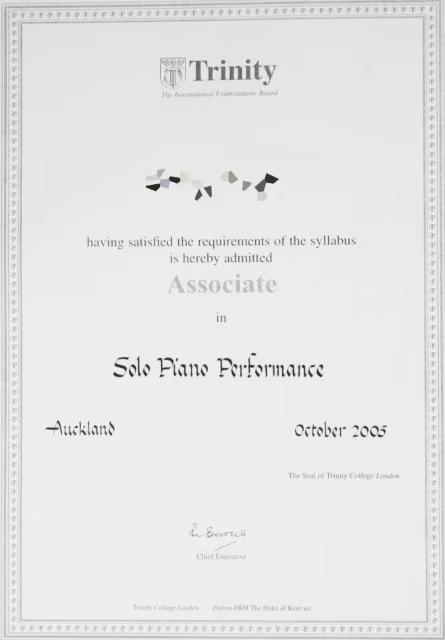
One miraculous early morning in 2005, Mr. Baker called me with the news.
I PASSED!
In fact, I didn’t just pass my ATCL exam; I achieved a Merit. (The grade system consists of 4 tiers: Fail, Pass, Merit, or Excellence.)
That phone call was about so much more than just a certificate. It was the triumphant end to my piano journey.
Last Notes
Passing the ATCL was the goal, but the real victory was what I learned along the way.
My childhood piano training taught me that music was about playing the right notes.
My second chance taught me that music is about connection, expression, and sharing a feeling with whoever is listening.
The grade was just a milestone; finding my voice and rediscovering the joy in music was the true win.

It just goes to show that sometimes, the perfect ending is the one where you finally learn to embrace the imperfections.
It’s those moments where you turn notes and keys into a language that speaks to the heart.
And while that felt like a happy ending, it was actually just the beginning of a whole new chapter — one where I finally started writing my own.
See you in Part 3: Becoming a Composer! 🎶
Share the Love!
As always, we aim to provide valuable content to help other families like yours live life to the fullest.
Remember to like, pin and share it with those who matter to you!
If you resonate with us, subscribe to stay in touch and we hope to see you in another chapter.
∞ Kida